1
/
of
1
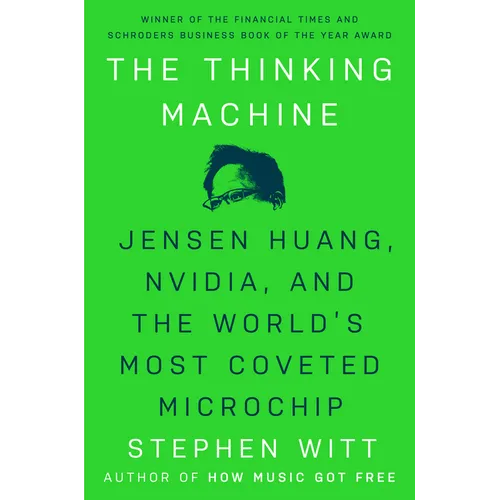
The Thinking Machine: Jensen Huang, Nvidia, and the World's Most Coveted Microchip - Hardcover
The Thinking Machine: Jensen Huang, Nvidia, and the World's Most Coveted Microchip - Hardcover
Regular price
$37.00 USD
Regular price
Sale price
$37.00 USD
Shipping calculated at checkout.
Quantity
Couldn't load pickup availability
by Stephen Witt (Author)
Winner of the FT and Schroders Business Book of the Year Award
Named a Best Book of 2025 by The Economist "Framed as a biography of Jensen Huang, the only CEO Nvidia has ever had, the book is also something more interesting and revealing: a window onto the intellectual, cultural, and economic ecosystem that has led to the emergence of superpowerful AI." --James Surowiecki, The Atlantic "A lively biography. . . . The story of how Nvidia became the hottest investment on Wall Street and a household name is fascinating." --Katie Notopoulos, The New York Times Book Review Nvidia is as valuable as Apple and Microsoft. It has shaped the world as we know it. But its story is little known. This is the definitive story of the greatest technology company of our times. In June of 2024, thirty-one years after its founding in a Denny's restaurant, Nvidia became the most valuable corporation on Earth. The Thinking Machine is the astonishing story of how a designer of video game equipment conquered the market for AI hardware, and in the process re-invented the computer. Essential to Nvidia's meteoric success is its visionary CEO Jensen Huang, who more than a decade ago, on the basis of a few promising scientific results, bet his entire company on AI. Through unprecedented access to Huang, his friends, his investors, and his employees, Witt documents for the first time the company's epic rise and its single-minded and ferocious leader, now one of Silicon Valley's most influential figures. The Thinking Machine is the story of how Nvidia evolved to supplying hundred-million-dollar supercomputers. It is the story of a determined entrepreneur who defied Wall Street to push his radical vision for computing, becoming one of the wealthiest men alive. It is the story of a revolution in computer architecture, and the small group of renegade engineers who made it happen. And it's the story of our awesome and terrifying AI future, which Huang has billed as the 'next industrial revolution, ' as a new kind of microchip unlocks hyper-realistic avatars, autonomous robots, self-driving cars, and new movies, art, and books, generated on command. This is the story of the company that is inventing the future.Author Biography
Stephen Witt is the author of How Music Got Free, which was a finalist for the Los Angeles Times Book Prize, the J. Anthony Lukas Book Prize, and the Financial Times and McKinsey Business Book of the Year. His writing has appeared in The New Yorker, Financial Times, New York, The Wall Street Journal, Rolling Stone, and GQ. He lives in Los Angeles, California.
Number of Pages: 272
Dimensions: 1.03 x 9.31 x 6.37 IN
Publication Date: April 08, 2025
Share